Friday, August 13, 2010

Milwaukee bike plan needs your support

The Bike Fed and the City of Milwaukee recently completed Milwaukee by Bike, the city's 2010 bicycle master plan that, if approved, will guide the development of bicycle policies and facilities in Milwaukee for the next decade. In addition to proposing more than 200 miles of new bikeways, the plan sets goals and objectives designed to increase the safety and ease of bicycling in the city.

If you live or bike in Milwaukee, please help ensure passage and implementation of Milwaukee by Bike by contacting your alder and the mayor to express your support for the plan. A form letter of support is available here, but your letter will be even more effective if you use your own words to explain why the plan is important to you and the city you love. Contact information for your elected officials can be found here.

Our list of frequently asked questions provides basic information about the plan and talking points on why the plan is important for Milwaukee.

Please show your support!

Thursday, August 12, 2010

Enter our Wisconsin bicycling photo contest!

The Bike Fed is holding a photo contest for pictures that represent the fun of bicycling in our state - whether by commuter bike, recumbent, coaster, racing bike, tricycle, mountain bike, tandem, hand-powered bike, BMX, cargo bike, trailer, or some kind of bike we've never heard of.

To enter, post your pictures to our Facebook page or email them to Kathryn Kingsbury, Bike Fed communication director. Include the location where you took the photos. You can also send entries to Attn: Photo Contest, Bicycle Federation of Wisconsin, 106 E. Doty St, Suite 400, Madison, WI 53703. Deadline for entries is August 20. Winners will be featured on the Bike Fed website and publications, and retain the copyright to their work.

Wednesday, August 11, 2010

Looking for answers in Allen Belonger's death


Allen Belonger was killed on July 11, 2009, while riding in Iowa County. As he descended a hill at 30 to 35 miles an hour, a 16-year-old driver named Eric Hendrickson "abruptly turned [his truck] in front of Belonger," according to a recently released state trooper's report. The report states that Hendrickson "failed to yield" even though Belonger was in his sight line for 10 seconds prior to the crash, and that the "manner in which Belonger was operating his bicycle was not a factor in this crash."

Despite these conclusions, no charges have been filed against Hendrickson. Nor has he received a ticket for failure to yield. According to the Milwaukee Journal-Sentinel, Hendrickson orginally received a citation related to intoxicated driving, but when tests showed no alcohol in his system, that citation was dropped and no other citations were made.

Belonger's friends at the Spring City Spinners cycling club are pressing Iowa County District Attorney Larry Nelson for answers. A recent letter to Nelson written by Spring City Spinners President Laura Fisher and co-signed by six other club members, along with Bonnie Belonger (Allen's widow) and Bike Fed Executive Director Kevin Hardman, says:
Our question is a simple one: Why was no ticket issued to Mr. Hendrickson? There is no defense to his driving that day. Our friend died a violent and needless death because this young man was not paying attention and violated the law, and not even a traffic ticket was issued. Why?

Please understand that we have no vendetta against Mr. Hendrickson. He must be
devastated by this tragedy, and no doubt will carry it with him the rest of his life. We also understand that you must be very busy in performing the important functions of your office. Nevertheless, it is our opinion that there must be some official condemnation of his actions. Otherwise, the public may very well and possibly quite reasonably conclude that your county does not take the safety and rights of bicyclists seriously. That type of attitude can only lead to a greater disrespect of cyclists' rights and therefore to more tragedy, not only in Iowa County, but throughout the State.

The Bike Fed fully supports the Spring City Spinners in their quest to find justice for Allen Belonger and make the roads safer for everyone, and we are working to educate motorists about the rules of the road as they pertain to bicyclists. (Please direct your friends and acquaintances to www.share4motorists.bfw.org for an introduction to these rules.) Yesterday, Tony Galli of WKOW 27 in Madison interviewed our Madison director, Amanda White, for a piece that laid out the problems with the case and why it's important for motorists to treat bicycles as the legal vehicles they are. You can see a summary of the piece, which aired on the evening news, here.

The Waukesha County case referred to at the end of the story was the Father's Day killing of Waukesha resident Brett Netke as he rode on Highway 18. He was hit from behind. The driver in the case has paid a $114 traffic ticket for failing to provide a safe passing distance and, according to the Milwaukee Journal-Sentinel, may receive a three-point license deduction. You can see a story on the case from Milwaukee's TMJ 4 here.

Tuesday, August 3, 2010

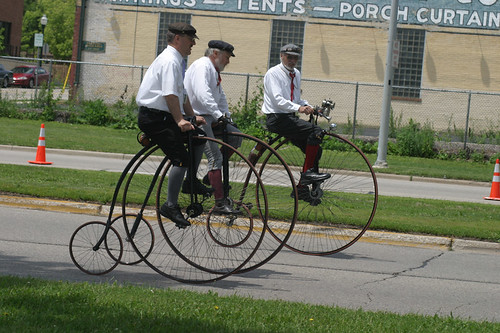
You Are Riding Bicycle History

Darryl Jordan Photography
Ride the Drive, June 2010, Madison. Photograph by Darryl Jordan. All rights reserved.

I've been having fun perusing through the Bike Fed's archives recently, and ran across this article by Jim Guthrie, a member of the Bike Fed and The Wheelmen, a group of antique bicycle enthusiasts:

Think you're riding the latest, greatest, high-tech version of the two-wheeled human powered vehicle. That's what I used to think. Then I joined a group of antique bicycle enthusiasts, The Wheelmen, and discovered that it's all been thought of and been done before. The big difference between the past and the present is materials; the space age has brought some neat things to bicycling. Let's take a brief trip through the history of bicycling. Perhaps you will end up as hooked as I am on this fascinating story.

Carriage makers started making bicycle prototypes in the early 1880's. They had iron tires, wooden wheels and, of course, a not-so-comfortable seat. People simply called them "wheels." These machines were "enjoyed" primarily by wealthy young gentlemen in Europe who had more leisure time than most. They would ride their "wheels" through the parks thrilling all who watched. Unlike bicycles of today, on these machines the rider had to pick up the front wheel in order to change directions. And to move it forward, the rider had to push his feet along the ground--hardly an efficient means of transportation.

By 1821, the first "wheel" had made its way to the United States. By the 1860's, riders could actually steer and pedal thanks to those two inventions. But getting anywhere on such dinosaurs still took a lot of effort. (Remember what it's like to pedal a child's tricycle.) To rescue the winded riders came the big drive wheel (the front wheel to which the pedals are attached on a tricycle). It was developed by an Englishman named Starly and dubbed the "highwheeler". People loved them because, compared to previous models, they could really cruise on their highwheelers.

When Starly completed his bike, he challenged a horseman to a 100-mile, one-day race. Starly won the race on his contraption and didn't require any hay, oats or water. The horseman required two mounts to complete the journey. Eventually, people began to see bicycling as a real means of transportation and not just a toy. It allowed them, through their own exertion, to reach their destination faster than on foot. And many ventured farther than they would have without a bike.

This new freedom caused societal changes; in a small but significant way, it contributed to the women's liberation movement. With bikes, young women more easily evaded the watchful eye of their chaperones. Bloomers, an early version of pants, were invented by a woman for females who wanted to ride a bicycle and still appear to be appropriately dressed.

Still other activities evolved as a result of the "wheel." Ordinary (highwheel) bicyclists irritated horsemen because the bike sometimes spooked the horses. Retaliation by horsemen involved sticking their riding crop in the spokes of the bicycle's front wheel causing the cyclist to catapult off the bike onto his head. This maneuver was called "taking a header" and injured or killed many early cyclists.

Poor roads were also a hazard to cyclists. Muddy rutted wagon lanes often made falling unavoidable. Logically, bicyclists began to organize for their own protection. Riding clubs formed throughout the Midwest and the East. Ultimately, a national organization, the League of American Wheelmen [editor's note: now the League of American Bicyclists], was formed. Its goals were to teach people how to ride and to improve road conditions. The League's Good Roads Movement resulted in the paving of many roads out East. In Wisconsin, however, we can credit the dairy industry with our fine paved country roads.

With all this interest in cycling, it was just a matter of time before bicycle design became more cyclist-friendly. That day arrived in 1885 when the Safety bicycle was introduced by its inventor, James Stanley. Featuring a rear-driven chain transmission and two wheels of approximately the same size, the Safety is the direct predecessor to today's mainstream models.

According to Nick Sanders in his book, Bicycle: The Image and the Dream, "By 1900, the bicycle had nearly reached perfection and was much the same as it is today." Oh, yes, and that seat that you all find so comfortable -- there have been many attempts over the last hundred plus years to improve it. But alas, even space-age materials can't improve some things.

Monday, July 26, 2010

Baileys Harbor works toward bike plan

Kevin Luecke, the Bike Fed's lead planner, has been working with towns in scenic Door County to develop bike plans. Bicycling is on the rise in this area, with hotel owner Bryan Nelson observing in the Door County Advocate, "Ten years ago I might have seen a couple of bike racks on the vehicles in my lots. Now it's about 80 percent. It used to be golfers."

Read the complete article here.

Friday, July 23, 2010

Basic Concepts of Bicycling in Traffic

This blog entry was originally written by Arthur Ross, the Pedestrian & Bicycle Safety Coordinator for the City of Madison and a member of the Bicycle Federation of Wisconsin, for our Wisconsin Bicyclist newsletter. We hope it helps you bike smarter and safer. For similar articles, please check out the Articles and Resources section of the Bicycle Federation of Wisconsin website.

The most basic concept to keep in mind when learning how to ride a bicycle safely in traffic is that your bicycle is a vehicle. The rules for riding a bicycle in traffic are the same as for driving any other vehicle, like a car. Following these rules of the road is the safest way to ride and your best defense against being involved in a crash.

Here are five essential concepts that will help you bicycle more safely:
  1. Ride on the right side of the road, always in the same direction as other traffic. Riding against traffic is unpredictable, especially to drivers at intersections, driveways or to those exiting parking spaces. Remember that bike lanes go one way only, in the same direction as other traffic on the street.
  2. Ride as far to the right as practicable, not as far right as possible.
    • Practicable means safe and reasonable.
    • Mid-block, your lane position depends largely on the width of the lane and your speed with respect to the speed of other traffic. The faster you are traveling (such as downhill) the farther left in the lane you need to be. The narrower the lane, the farther left you need to be to ensure that overtaking motorists will pass you safely. Wisconsin law requires a motorist passing a bicyclist to give at least three feet of clearance when passing.
    • Stay far enough away from the curb, or from the edge of the road, to avoid hazards such as sand, broken glass and potholes that tend to accumulate there. About three feet is typical. Also ride at least three feet from parked cars to avoid a suddenly opened car door.
    • When approaching and reaching an intersection, your lane position depends upon your destination. On the right for a right turn, towards the center if going straight, to the left (or in a left turn lane) for a left turn.
  3. Turns are made the same way on a bicycle as they are when driving a car. To change your lane position, or your position within a lane, first look behind you to see if there is any other traffic nearby. Traffic in the lane you want to move into has the right of way. Signal and change lanes/position within a lane when there is a safe opening in traffic. Again, this is the same way you change lanes and turn as when driving a car. A left turn can also be made by riding straight through the intersection, stopping, and walking or riding your bicycle across the street when safe.
  4. Obey all traffic signs and signals. These apply to bicyclists as well as motorists. Be especially alert for yield and stop signs, traffic signals, and one-way streets. Obeying traffic signs and signals is your first defense against crashes, and is the best way to gain respect from other road users.
  5. Ride defensively. Be aware of what is going on around you, both in terms of roadway conditions as well as other traffic. Watch the road for hazards like sand, broken glass, potholes and railroad tracks. Watch side streets, driveways, alleys and parked cars for traffic that may enter the street in front of you or turn across your path. Remember that trees, shrubs, fences, bright sunlight and darkness can make it difficult for you to see and for others to see you. Adapt your riding style to minimize these and other hazards.
At night, use a white headlight and a red rear reflector. Many bicyclists also use a red flashing light on the rear of their bicycles. During the day, wear bright colors to help others see you.

Know and watch for others' mistakes. Some common situations to be alert for include: a motorist coming toward you who turns left in front of you; a motorist passing you then turning right in front of you; a motorist pulling out from a stop sign, driveway or parking space without yielding to you.

Finally, help fight road rage by respecting others' rights. If you, as a bicyclist, want to earn the respect of motorists and pedestrians, then you need to respect their rights as well. Never compromise someone else's safety for your own convenience.

Tuesday, July 13, 2010

Milwaukee 2010 Bicycle Master Plan Open House is Tomorrow

For the last two years, the Bike Fed has been working with the City of Milwaukee on a bicycle plan that will more than double the miles in the city's bicycle network and otherwise make it easier for Milwaukeeans to pedal about town. Tomorrow, you'll have the opportunity to learn the details of the plan and make written comments at an open house at the Zeidler Municipal Building.

    What: Milwaukee by Bike 2010 Bicycle Master Plan Open House

    When: Wednesday, July 14, 2010, 4-7 p.m.

    Where: 1st Floor Conference Room, Zeidler Municipal Building, 841 N. Broadway, Milwaukee

    Who: Anyone who uses Milwaukee's streets or bike paths

    More info: www.milwaukeeplan.bfw.org


We hope to see you there! If you aren't able to make the meeting, you are welcome to read the plan at www.milwaukeeplan.bfw.org and submit comments via email or postal mail:
    Bicycle Federation of Wisconsin
    ATTN: Milwaukee Bike Plan
    106 East Doty Street, Suite 400
    Madison, WI 53703

Friday, July 9, 2010

How To Use Hand Signals Safely while Cycling in Traffic

Ran across this video on REI's YouTube channel today. Nice, simple and quick introduction to using hand signals on the bike.

And don't think hand signals are just for roads. They are great for preventing collisions on bike paths, too.

Wednesday, July 7, 2010

Help kids with disabilities lose their training wheels

We got this email from the Madison Area Down Syndrome Society (MADSS) today and thought some of you might be interested in volunteering. It sounds like a really fun opportunity:
Each summer the Madison Area Down Syndrome Society (MADSS) bring the Lose the Training Wheels Bike Camp to our area to help children with different disabilities learn to ride on two wheels. In addition to helping provide children with disabilities another way to stay physically fit and to socially engage with their peers, learning to ride on two wheels often inspires new found confidence and independence in program participants. ...

We are once again seeking more than 80 physically fit volunteers to serve as "spotters" and in other capacities during the week of July 12-16th. ... We are also still seeking sponsors and donors for this event.

Lose the Training Wheels is a national program that boasts an 85% success rate in getting kids confidently riding without training wheels. Interested in helping out? Check out MADSS Bike Camp page.

If you're not in the Madison area, but would like to see the program brought to your part of the state, check out their camp schedule page and read the second paragraph from the top for more information.

Milwaukee hosted a Lose the Training Wheels camp in June. Contact the Autism Society of Southeastern Wisconsin if you'd like to be involved with next year's camp.

Tuesday, July 6, 2010

Thanks for a great Tour de Fat!

We had a wonderful time at Milwaukee's first-ever Tour de Fat on Saturday, July 3, raising more than $12,000 for the Bike Fed. Thousands of people gathered to celebrate bicycling. We were impressed by the costumes that people came up with, and thought our executive director's daughter did a great job picking out a sundress for him to wear.

Thanks to the more than 100 volunteers who made the festival happen. You rock! (Want to help out at next year's Tour de Fat? Contact hilary.carroll@bfw.org to put your name in the hat.

Congratulations to Christopher Miller, who won the car-bike exchange contest and got to trade in his 2000 Saturn SL1 for a handbuilt Black Sheep Bikes commuter bicycle.

Our hats also go off to the Bike Fed's own Jake Newborn, who won the slow biking contest. All those years of doing track stands have finally paid off!

Tour de Fat raised about $12,000 to help the Bike Fed continue its work making Milwaukee a better place to bike. The low-impact festival produced 134 pounds of compost, 45 pounds of recycling and three pounds of trash.

If you missed the event or just want to relive its glory, these news stories did a good job of capturing its spirit:


We'll be adding pictures to our Web site and Flickr page in the next day or two. Keep your eyes open!